|
|
|

|
|
|
|
|
 |
菱花口六瓣瓜棱瓶 时代:宋代 窑口:龙泉窑 (青瓷) 尺寸:高11英寸 描述:菱花式口;长颈,颈中部刻划双线纹饰;体呈对称六棱瓜瓣,鼓腹下收;圈足外撇;外通体施青釉,施釉到底,釉层不厚,釉色显幽雅滋润;釉面开裂纹片,为错落有致的极细透明无色纹片;胎质坚致,露胎处呈褐色;造型挺拔秀丽,线条流畅,此宋代造型器物较为少见。
Description: Chinese Porcelain Vase Condition: good overall. Dimension: 11 inches height. (Lot 395: Chinese Porcelain Vase; Antique ReaderLong Island City, NY, USAugust 16, 2015) 瓶型特点: 花口瓶因瓶口如开放的花瓣而得名,始于唐代,至宋代较为流行,细颈、圆腹、撇足。瓜棱瓶是宋瓷常见瓶式,撇口、直颈、长圆瓜棱形腹,圈足做花瓣式外撇,特点是瓶的腹部由凸凹的弧线组成似瓜棱式的形体。此菱花口六瓣瓜棱瓶结合了菱花口和瓜棱而制,颈部刻划双线纹饰,器型端正,实属罕见。 |
|||
 |
 |
|||
 |
 |
|||
|
越窑青瓷瓜棱花口瓶 高度:11 英寸 (28.3 厘米) | Height: 11 in. (28.3 cm) 本品撇口,作优雅的五瓣花口状,宛若绽放的葵花。长细颈,颈部饰双弦纹。丰肩,器身腹部均匀凸起五瓣瓜棱,线条圆润饱满,骨肉亭匀。下接圈足,足端露胎,胎质坚致,呈现出高古越窑特有的灰白色。露胎与釉面交界处可见一圈自然的火石红。通体施艾青色釉,釉质温润如玉,宝光内敛,微泛淡淡的黄色,极具晚唐五代“秘色瓷”之遗韵。
此瓶造型完美融合了宋代文人的仿生极简美学。更为珍贵的是,其底部贴有早期菲律宾国家博物馆(National
Museum of the Philippines)
官方鉴藏标签,证实其曾作为重要的外销瓷见证了10世纪“海上丝绸之路”的辉煌历史。本品流传有序,来源清晰,为不可多得的越窑高古瓷珍品。
It is covered overall with a luminous, smooth grayish-green
celadon glaze of characteristic 'Ai' (mugwort) tone, pooling
slightly along the lobed recesses to accentuate its organic form.
The unglazed foot rim reveals a compact grayish-white stoneware
body with a distinct orange-buff line of burning at the glaze
margin.
Remarkably, the base retains an old official inventory label from
the National
Museum of the Philippines
, providing crucial evidence of its historical journey as
a high-grade trade luxury along the maritime silk road. This
highly rare vessel stands as a textbook example of 10th-century
Yue ware aesthetics and boasts impeccable provenance.
|
|
|||
| 菲律宾国家博物馆收藏标签--参考:
這類帶有「NATIONAL
MUSEUM / PHILIPPINES / RP」紅色字樣及太陽徽記老標籤的器物,並非從博物館庫房偷盜或私自流出的「館藏文物」,而是
1960 至 1980
年代菲律賓國家博物館(National
Museum of the Philippines)履行國家文物出口審批職能時,為合法批准出境的民間古董貼上的「文物出口許可/登記標籤(Export
Permit / Registration Sticker)」。
歷史背景(1960s–1980s) :菲律賓在 1966 年頒布《文化遺產保護與保存法》(Republic Act No. 4846)後,指定菲律賓國家博物館 作為全國唯一的古董與文化財產登記、鑑定與出口審批機構。 [1] 標籤的真實含義 :當時在馬尼拉古玩市場(如著名的 Ermita 古董街)活躍著大量歐美外交官、駐軍人員、跨國企業高管與亞洲藝術古董商。當外國藏家或古董商在菲律賓合法購買到中國外銷瓷(如宋元明清龍泉青瓷、景德鎮青花)或東南亞高古瓷後,必須將器物送交菲律賓國家博物館的文物管制部門進行鑑定登記。
|

菲律宾国家博物馆(National Museum)文化资产部(Cultural Properties Division)于 2000年5月1日 颁发的《官方登记证书》(Certificate of Registration): • 名称 (Name of Item):Flower vase(花瓶)。完全符合该器物花口瓶的品类。 釉色特征:white glazed with greenish tinge(白中带绿意/青意的釉面)。这非常精准地描述了五代北宋越窑“艾青色”或“粉青色”在西方或早期非专业眼中的视觉呈现(介于青白瓷与典型青瓷之间)。 造型细节 (Crucial Details): • cupped mouth(杯状口/花口) • embossed lotus leaf design on the shoulder(肩部有浮雕莲叶纹/弦纹起伏) • eroded lower portion(器身下半部分有剥蚀/自然的窑裂或土蚀痕迹)──这与底足及器身下部老化的皮壳特征完全对上。 年代断定 (Chronology):Ht. 30 cm. Sung Dynasty. (Imported from China)。高度写明为 30 厘米(折合约 11.8 英寸,扣除手工测量的微小误差,与 11 英寸完全吻合),断代为宋代(或早期),并明确注明“从中国进口”。
|
|||
|
宋龙泉窑青釉--参考:
|
 |
|||
| 唐代的越窑、宋代的龙泉窑、官窑、汝窑、耀州窑都属青瓷窑系。早在商周时期就出现了原始青瓷。目前在河南郑州、安阳、洛阳、巩县、偃师,河北_城、北京,陕西西安,山东益都,安徽屯溪,江苏南京、丹徒等地商周遗址和墓葬中,先后出土了许多原始青瓷及残片,主要器形有尊、碗、盘、瓶、瓮、罐、豆等。经科学测定,它们已基本上具备了瓷器的特征,但与后来成熟阶段的青瓷比较,还带有原始性,如气孔较大,胎料中杂质较多,釉色还不够稳定,故称为原始青瓷。青瓷历经春秋战国时期的发展,到东汉有了重大突破。在浙江、江苏、江西、安徽、湖北、河南、甘肃等地东汉墓葬和遗址中,都出土了东汉的青瓷器。 | 因浙江上虞一带曾是古越人的故乡,战国时属越国管辖,唐朝时称越州,所以这一带的瓷窑统称越窑。到三国两晋南北朝时期,南北各地烧制青瓷更为普遍,瓷窑增加,种类繁多,质量进一步提高,南方和北方所烧青瓷各具特色。南方青瓷,一般胎质坚硬细腻,呈淡灰色,釉色晶莹纯净,常用类冰似玉来形容。北方青瓷胎体厚重,玻璃质感强,流动性大,釉面有细密的开片,釉色青中泛黄。河北景县北齐封氏墓出土的青瓷莲花尊,造型非常漂亮,堪称北方青瓷的代表作。 |
 |
||
|
|
||
|
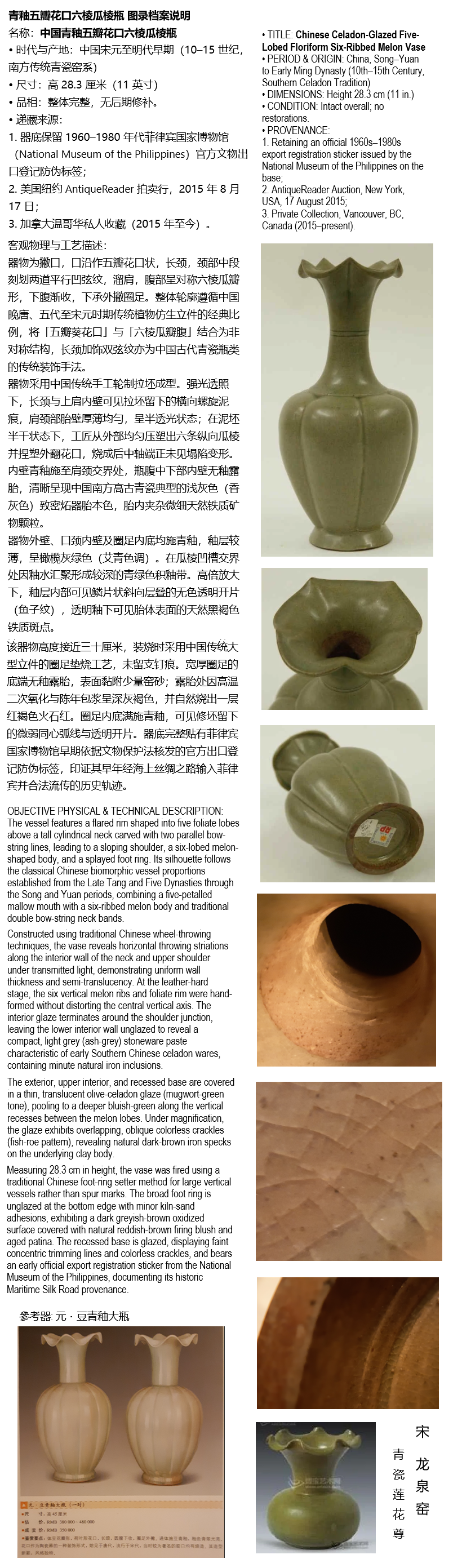
青釉五瓣花口六棱瓜棱瓶
图录档案说明书(网页双语版)
【中文编目档案】
客观物理与工艺描述
:
器物为撇口,口沿作五瓣花口状,长颈,颈部中段刻划两道平行凹弦纹,溜肩,腹部呈对称六棱瓜瓣形,下腹渐收,下承外撇圈足。整体轮廓遵循中国晚唐、五代至宋元时期传统植物仿生立件的经典比例,将「五瓣葵花口」与「六棱瓜瓣腹」结合为非对称结构,长颈加饰双弦纹亦为中国古代青瓷瓶类的传统装饰手法。
器物采用中国传统手工轮制拉坯成型。强光透照下,长颈与上肩内壁可见拉坯留下的横向螺旋泥痕,肩颈部胎壁厚薄均勻,呈半透光状态;在泥坯半干状态下,工匠从外部均匀压塑出六条纵向瓜棱并捏塑外翻花口,烧成后中轴端正未见塌陷变形。内壁青釉施至肩颈交界处,瓶腹中下部内壁无釉露胎,清晰呈现中国南方高古青瓷典型的浅灰色(香灰色)致密炻器胎本色,胎内夹杂微细天然铁质矿物颗粒。
器物外壁、口颈内壁及圈足内底均施青釉,釉层较薄,呈橄榄灰绿色(艾青色调)。在瓜棱凹槽交界处因釉水汇聚形成较深的青绿色积釉带。高倍放大下,釉层内部可见鳞片状斜向层叠的无色透明开片(鱼子纹),透明釉下可见胎体表面的天然黑褐色铁质斑点。
该器物高度接近三十厘米,装烧时采用中国传统大型立件的圈足垫烧工艺,未留支钉痕。宽厚圈足的底端无釉露胎,表面黏附少量窑砂;露胎处因高温二次氧化与陈年包浆呈深灰褐色,并自然烧出一层红褐色火石红。圈足内底满施青釉,可见修坯留下的微弱同心弧线与透明开片。器底完整贴有菲律宾国家博物馆早期依据文物保护法核发的官方出口登记防伪标签,印证其早年经海上丝绸之路输入菲律宾并合法流传的历史轨迹。
【英文编目档案
(Objective Bilingual Catalogue Entry)】
OBJECTIVE
PHYSICAL & TECHNICAL DESCRIPTION
:
The vessel features a flared rim shaped into five foliate lobes above a tall cylindrical neck carved with two parallel bow-string lines, leading to a sloping shoulder, a six-lobed melon-shaped body, and a splayed foot ring. Its silhouette follows the classical Chinese biomorphic vessel proportions established from the Late Tang and Five Dynasties through the Song and Yuan periods, combining a five-petalled mallow mouth with a six-ribbed melon body and traditional double bow-string neck bands.
Constructed using traditional Chinese wheel-throwing techniques,
the vase reveals horizontal throwing striations along the interior
wall of the neck and upper shoulder under transmitted light,
demonstrating uniform wall thickness and semi-translucency. At the
leather-hard stage, the six vertical melon ribs and foliate rim
were hand-formed without distorting the central vertical axis. The
interior glaze terminates around the shoulder junction, leaving
the lower interior wall unglazed to reveal a compact, light grey
(ash-grey) stoneware paste characteristic of early Southern
Chinese celadon wares, containing minute natural iron inclusions.
The exterior, upper interior, and recessed base are covered in a
thin, translucent olive-celadon glaze (mugwort-green tone),
pooling to a deeper bluish-green along the vertical recesses
between the melon lobes. Under magnification, the glaze exhibits
overlapping, oblique colorless crackles (fish-roe pattern),
revealing natural dark-brown iron specks on the underlying clay
body.
Measuring 28.3 cm in height, the vase was fired using a
traditional Chinese foot-ring setter method for large vertical
vessels rather than spur marks. The broad foot ring is unglazed at
the bottom edge with minor kiln-sand adhesions, exhibiting a dark
greyish-brown oxidized surface covered with natural reddish-brown
firing blush and aged patina. The recessed base is glazed,
displaying faint concentric trimming lines and colorless crackles,
and bears an early official export registration sticker from the
National Museum of the Philippines, documenting its historic
Maritime Silk Road provenance.
|
||
 |
||
|
【中文專業推介版】
拍品建議定名
:中國五代至宋元時期(10–13
世紀)南方名窯青釉五瓣花口六棱瓜棱瓶
( 尺寸 :高 28.3 厘米(11 英吋)
核心收藏價值與送拍亮點
:
【英文專業推介版
(Curatorial & Consignment Pitch - Major Auction House
Standard)】
PROPOSED
TITLE
: A RARE LARGE CHINESE CELADON-GLAZED FIVE-LOBED
FLORIFORM SIX-RIBBED MELON VASE
PERIOD : Five Dynasties to Song–Yuan Period (10th–13th Century), Southern Celadon Tradition (Previously catalogued by AntiqueReader Auction, New York, 17 August 2015, as Five Dynasties – Early Northern Song Dynasty, 10th Century, Yue Ware) DIMENSIONS : Height 28.3 cm (11 in.)
CURATORIAL
& MARKET HIGHLIGHTS
:
|
||
| 来源:2015年8月17日由美国纽约AntiqueReader拍卖公司拍出。 |


